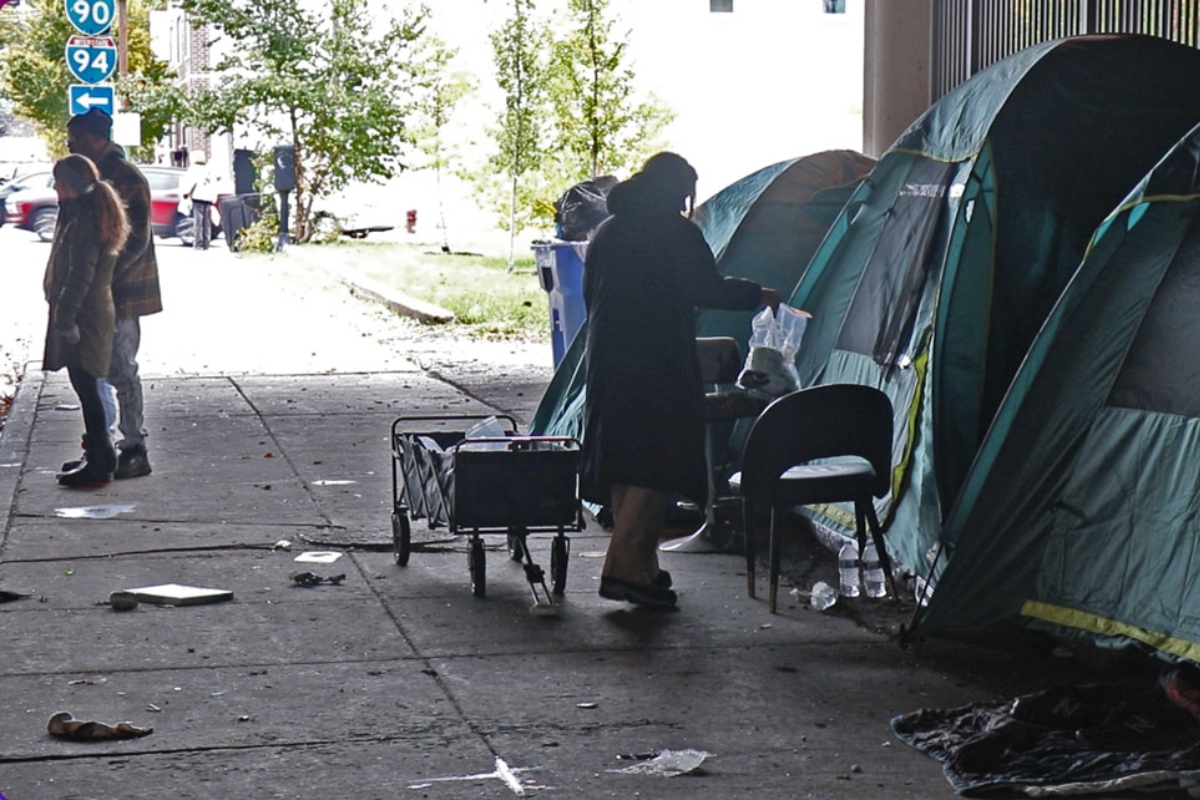
Chicago, IL (CAPITOL NEWS ILLINOIS) – Homeless people are much more likely to face emergency room visits, hospitalizations and premature death than the general population, and state officials are struggling to stem the crisis, according to a new report by the Illinois Department of Public Health.
Underlying these efforts to end homelessness is the Home Illinois Plan, the IDPH’s overarching multiagency strategy to address housing instability, in which the Housing First model is a core pillar. The model emphasizes that homelessness is not driven by individual shortcomings but by housing costs and systemic inequities.
Still, in his 2026 budget address on Feb. 18, Gov. JB Pritzker proposed that funding for Home Illinois be reduced by $7.6 million, bowing to headwinds from federal budget cuts and Illinois budget belt-tightening. It was the second straight year seeing a cut in funding for housing programs, including Pritzker’s signature program designed to eliminate homelessness in the state.
That means people who are homeless across Illinois and especially in urban areas will need to rely more on community-based programs.
Dr. Amanda Bradke, a physician at Rush University Medical Center, participates twice a week with a local nonprofit at a walk-in clinic in Chicago. While she can provide medical care, these centers often offer mental health services, laundry, showers, housing support, and career and legal resources.
“Our big overarching tenet of the work that we’re doing with the center is meeting people where they’re at,” Bradke said. “So that’s also, in terms of their needs, making sure that we have the right staff and the right resources to do that, but also physically bringing care into the community.”
Bradke’s work is a piece of a much larger network of homeless services offered by nonprofits, but their challenge is immense.
An estimated 10,000 people in Illinois experienced “literal homelessness,” according to the IDPH report. An estimated 108,000 to 233,000 are living in unstable arrangements.
The IDPH report found that 2,996 people died statewide from 2017 to 2023 while experiencing homelessness. Their average age at death was 20 years below the statewide average. More than 300 of those who died were veterans, and 30 had worked in the public sector, including as police officers, paramedics and correctional officers.
Those experiencing homelessness are far more likely than the public at large to die of drug overdoses, traumatic injuries and excessive cold — and three times more likely to be murdered.
The report has state and nonprofit leaders asking about the need to provide well-rounded services that proactively address the needs of homeless communities.
The state’s Office to Prevent and End Homelessness will focus on interventions that “help close the gap on health care delivery to people experiencing housing insecurity,” based on the report’s data.
“People who experience homelessness tend to live 20 years less than people who are housed, and tracking how this gap changes over time can help assess how interventions are working, ” the Illinois Department of Human Services, which oversees OPEH, said in a statement.
The IDPH report found that from 2017 to 2023, approximately 10,000 people in Illinois experienced “literal homelessness” and more than 200,000 people were in unstable housing situations. During the same time period, more than 75,000 people experiencing homelessness in Illinois accounted for more than 1.8 million hospital visits.
Eugenia Olison, a senior policy advisor at OPEH and an author of the IDPH report, said the study can open more pathways for identifying people experiencing homelessness in hospital settings to provide social services. Pritzker established OPEH and appointed Christine Haley as Illinois’ first chief homeless officer in 2021 through his Executive Order to Fight Homelessness in Illinois.
“My hope for this report is to not only bring awareness to the amount of individuals that are suffering while experiencing homelessness,” Olison said, “but also different advocacy ways that we could highlight the need for additional resources, additional housing, additional health care access for people experiencing homelessness.”
Street outreach programs
Street outreach programs that bring services directly to homeless people are not new, according to Sherri Allen-Reeves, chair of the Chicago Continuum of Care, which is a membership organization funded through the U.S. Department of Housing and Urban Development. Chicago CoC is partnering with Street Samaritans, a Chicago-based nonprofit dedicated to fighting homelessness through direct outreach, to bring an in-person space to meet and help people facing homelessness.
“By the end of the month, and hopefully, really soon, we’ll be opening up a drop-in center in the Chicago Lawn area … just so people have a place to go and get a hot meal and shower,” Allen-Reeves said.
Illinois’ homeless services infrastructure is headed in the right direction, Allen-Reeves said. Efforts by both nonprofits and state offices to collect data and build networks of communication with homeless communities have steadily increased since Pritzker’s executive order in 2021.
Because of the links between food insecurity, mental and physical health, and housing status, at Nourishing Hope, one of the largest and longest-operating hunger relief organizations in Chicago, advocates aim to provide access to food, mental health resources and social services for all Chicagoans. In 2024, Nourishing Hope provided the equivalent of more than 4.5 million meals to people in need.
Through the organization’s Health and Hope Program, partnerships with local hospitals allow for the identification of individuals who are in need of emergency food support, longer term food services and other social services.
“We really try to address food insecurity from a holistic perspective,” Lisa Mayse-Lillig, chief program officer at Nourishing Hope Chicago, said, adding it’s about “being able to have those partnerships with health care providers so that they understand where they can make that referral and that connection with patients to get access to that nutritious food.”
Housing First model
While Pritzker’s administration has been in tune with supporting homelessness and housing services, budget cuts over the last two years have dampened efforts to address the affordable housing crisis, said Niya Kelly, director of state legislative policy, equity and transformation at the Chicago Coalition to End Homelessness.
“As we are seeing rents get higher and the price of items continue to grow and wages stay stagnant, we know that we’re going to see more people who are unstably housed,” Kelly said. “We want the governor’s office and the General Assembly to say, ‘We see these folks, and we’re going to make sure that we’re providing all the services that we can, not only get them housed, but get them the services that they need in order to stay housed.’”
Sen. Rachel Ventura, D-Joliet, who is vice chair of the Senate Public Health Committee, said she disagrees with the proposed cut and believes the state should prioritize affordable housing in the face of cuts at the U.S. Department of Housing and Urban Development.
“Since the 1970s, the federal government has removed funding for public housing, and then states and local governments followed in suit to the point that we have very little public housing today,” Ventura said.
Kelly said addressing housing instability and affordability is the first step to ensuring that the number of people experiencing homelessness and the number of premature deaths decrease, as the Housing First model emphasizes.
“When we talk about the hierarchy of needs, knowing where you’re going to sleep at night absolutely impacts your quality of life and your mental health,” she said. “And so making sure that the person is in housing first makes the most sense, and then doing wraparound services.”
Jacques Abou-Rizk is a graduate student in journalism with Northwestern University’s Medill School of Journalism, Media, Integrated Marketing Communications, and fellows in its Medill Illinois News Bureau working in partnership with Capitol News Illinois.
Capitol News Illinois is a nonprofit, nonpartisan news service that distributes state government coverage to hundreds of news outlets statewide. It is funded primarily by the Illinois Press Foundation and the Robert R. McCormick Foundation.